
J. Rufus Fears, Ph.D.
Question 1: God. Does God or do gods exist? What is the nature of the divine? Does God or do the gods care about humans and their actions?
- This theme includes books of polytheism, such as the Iliad, and books of monotheism, including the biblical book of Exodus, the Gospel of Mark, and the Koran.
Question 2: Fate. What is fate? Do events, great and small, happen because they are predetermined by divine will or simply by chance and random occurrence? Do humans have free will? Do you determine your life, or is it already predetermined? Are you free to choose, or has your DNA already made the choice for you?
- Marcus Aurelius explores this theme.
Question 3: Good and evil. What do we mean by good and evil? Are there consequences for our actions, whether freely chosen or predetermined? If there are consequences for our actions, does this mean that there are standards by which to judge these actions? Who or what determines those standards? Are those standards enduring for all time?
- Although Bonhoeffer believed in absolute good, he also believed that telling lies was necessary at times.
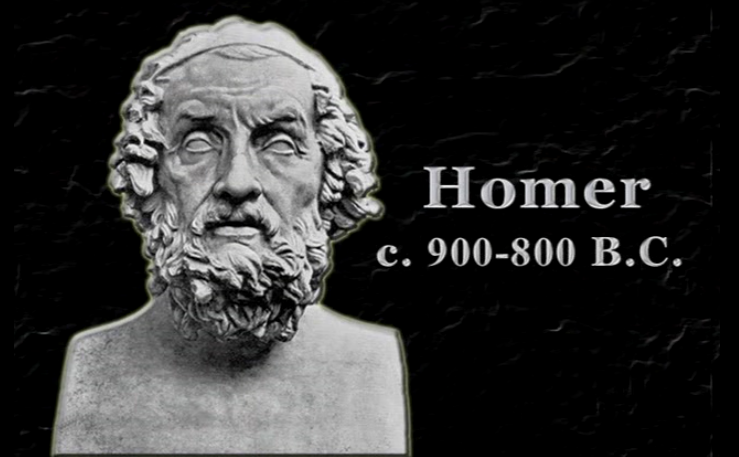
- Homer, for example, praises Odysseus as a man who knew how to tell many lies and tell them well.
Question 4: How should we live? Our answers or failures to answer or even to ask these questions have consequences. They determine how we, individuals, groups, nations, live our lives. They give us the values or absence of values to determine how we act toward others.
How do we define a great book?
- A great book has a great theme. It discusses ideas of enduring importance.
- A great book is written in language that elevates the soul and ennobles the mind.
- A great book must speak across the ages, reaching the hearts and minds of people far removed in time and space from the era and circumstances in which it was composed. Thus, a great book summarizes the enduring values and ideas of a great age and gives them as a legacy to future generations.
- Great books are an education for freedom.
Bonhoeffer, Letters and Papers From Prison
What is a great book? Great theme, noble language, universality are fundamental elements in a great book. But most important is the ability of such a book to speak to you as an individual and to influence your life and the ideals by which you live.
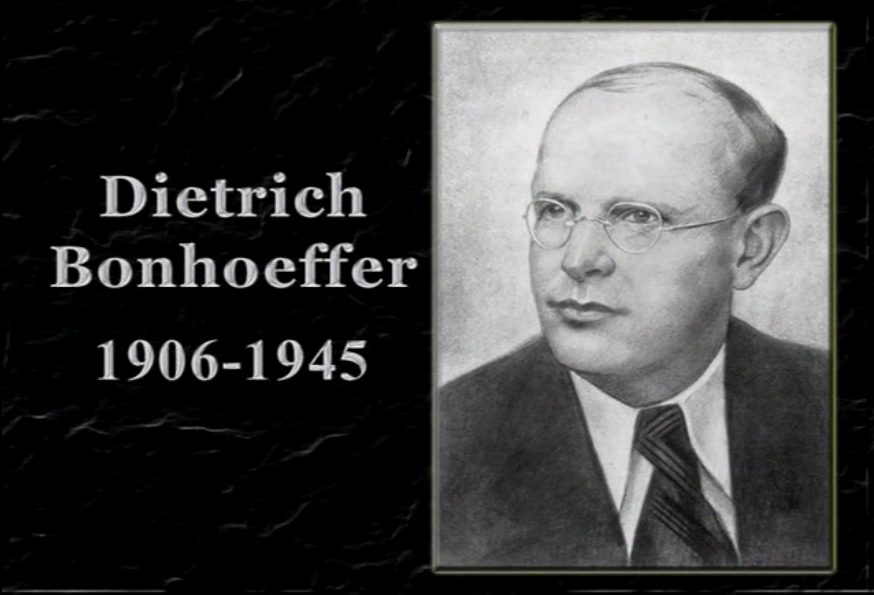
In prison, Bonhoeffer read Plutarch, the Bible, and the Prison Dialogues of Plato. He realized that such works could speak in a different voice at different times of life, in times of triumph or times of trial.
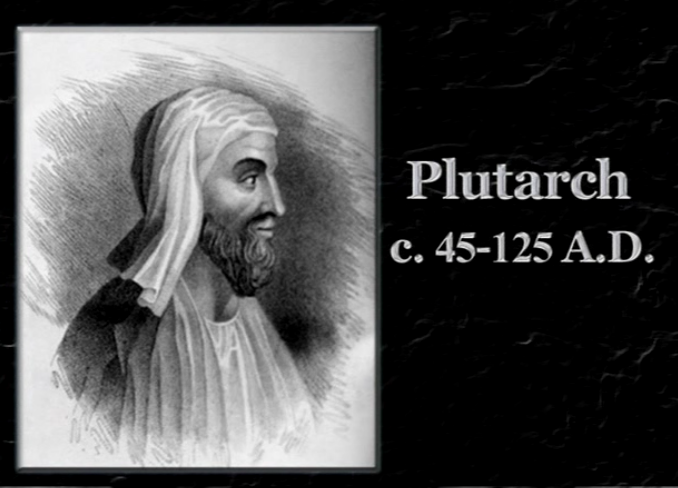
Bonhoeffer had read the same books as those who tormented him. His judge, Otto Thorbeck, had received the same type of classical education as Bonhoeffer. Judge Thorbeck believed that his duty
was to carry out trials that he knew were wrong. Bonhoeffer, however, read books with the moral compass of absolute right and wrong. Great books themselves are no cure. They offer a means to live life in a way that can do either good or harm.
« Those books speak to me! »
« Questions that we have at 20 or 60 years old! »
« L’amour, c’est une question d’Honneur, d’Ambition et de Courage »:Illyade, Évangile de Marc, Faust.
« Internet est rempli d’informations. » « Il faut transformer information en connaissance… connaissance en sagesse, à appliquer dans votre propre vie. »
« Un livre doit être inspirant »
Homer, Iliad
The Iliad of Homer and the Bible are the two fountainheads of our literature. Both are attempts to explain the ways of God to man. For Homer, god is not one but many.
The fundamental themes of the Iliad are gods, fate, and the meaning of life. For Homer, fate and the gods were means by which a person could learn more about the meaning of life.
The Iliad consists of 15,693 lines, composed around 800 B.C. by a single creative genius, Homer.
Homer composed the work in Asia Minor, in what is now Turkey.
This narrative poem describes a few days in the struggle between the Greeks and the Trojans that lasted more than 10 years.
Central questions of the Iliad include the following:
A. Why are we here?
B. Why is war waged?
C. Why do innocents suffer?
One lesson of Homer is that the gods care about good and evil.
A. Absolute right and absolute wrong exist.
B. The gods ultimately punish what is wrong and reward what is right.
C. Mortals lack vision to understand what is good and what is evil until it is too late.
D. Homer believed that people do not understand the ways of the gods. The Iliad was a means of beginning to gain wisdom.
- Homer and the Bible agree that fear of god is the beginning of
wisdom. - The omens of the gods should be taken seriously, because they are
the means by which the gods make their will known.
Achilles gives us this lesson: All mortals must die, but how people live their lives is what matters.
L’Homme n’apprends que par la souffrance, en relisant, vie après vie les mêmes textes.
Croire en la TRANSMIGRATION… le transfert de l’âme d’un corps à un autre.
Marcus Aurelius, Meditations
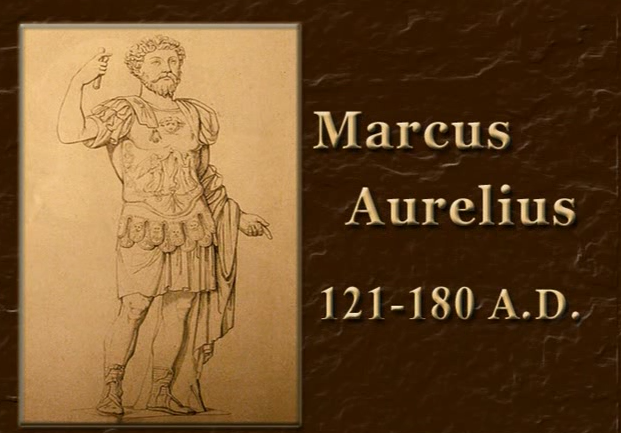
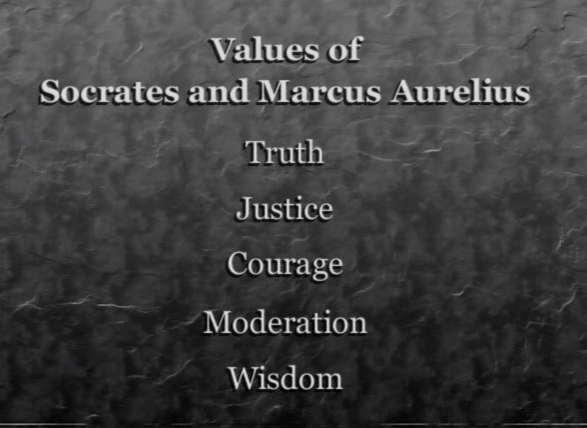
Marcus Aurelius as one of the most noble of the Roman emperors. His book of Meditations was written to himself. Wisdom lies in understanding that we can control only our minds, what we think with our minds, and our actions based on those thoughts.
Marcus had wanted to be a philosopher. The term philosopher referred to a love of wisdom; it was not a narrow academic specialty but the search for wisdom needed to live one’s life.
Each person has a soul and that soul partakes (« participant ») of the essence of god. Fate, through god, has decreed a destiny for everyone.
The Stoics—who played a major role in this transition—taught that god is the universe and is all-good, all-beneficent, and all-knowing. They, too, believed that god gave each individual a soul and decreed a particular fate for each individual. This monotheistic idea paved the way for Christianity.
A person might believe that order existed in the universe or that the universe consisted of a random collision of atoms.

The mind must be trained. Meditation and contemplation, rather than books, lead to understanding.
« Vous devez rester serein à l’intérieur de votre forteresse, votre âme et votre esprit. Votre corps est un véhicule pour faire le bien.Il n’est pas important de croire ou de ne pas croire en Dieu. Il n’y change rien. Il existe un ordre dans l’univers. Il existe le chaos dans les atomes. Mais il ne devrait pas y avoir de changement dans la façon de vivre votre vie »
No one can control the mind of another person. Actions of other people do not harm an individual; what matters is the individual’s opinion of that action. An individual has been harmed only if he believes that he has been harmed (« blessé »).
« Vol de voiture, perte d’emploi, votre épouse vous quitte… ce sont toutes des situations externes à ce que vous êtes. Même la Gloire n’est rien. Si quelqu’un est méchant envers vous, il ne peut vous blesser que si vous acceptez son opinion. Vous demeurez ce que vous êtes. Ce n’est que son opinion, pas la vérité. Si vous considérez que tout ce qui se présente est bon, suivant la justice de Dieu, restez en paix, en confiance. Faites de votre mieux, selon Sa Volonté. Traitez les autres comme vous voulez être traités. »
According to Marcus Aurelius, a fear of death implies wisdom in an area that people know nothing about. Death is as natural as life.
“Get out of bed, get on with your duty, and appreciate what is around you. That is the meaning of life.”
The goal of education, he believed, was to enable people to understand their duty, to find their assigned tasks, and to perform them to the best of their abilities.
Bhagavad Gita
Composed in the same period as the Iliad, this poem, “The Song of God,” is also an epic statement of polytheism, of the belief that god has fashioned many roads to the truth.
The Bhagavad Gita proclaims that beyond the multitude of deities, there is an all-encompassing, single divine power. This god is truth, and the search for wisdom is the pathway to god and to the freedom that is eternal.
Freedom comes by overcoming our desires for what is false and devoting ourselves and our work to what is true and eternal.
Around 1800 B.C., the flourishing civilizations around the Indus River were overrun by invaders from the west.
The language of these invaders was Sanskrit, also the language of the Bhagavad Gita. Sanskrit was related to Persian and more distantly to Greek, Latin, and the Germanic languages. These invaders, who called themselves Aryans, meaning “nobles,” imposed their rule by conquest.
Its author is unknown.
The first word of the Bhagavad Gita is dharma, or “truth.”
In this allegory, Krishna, the charioteer of Arjuna, is also the image of the supreme god of the universe; Arjuna is everyman, the soul. Krishna explains to Arjuna how he must travel the battlefield of life.
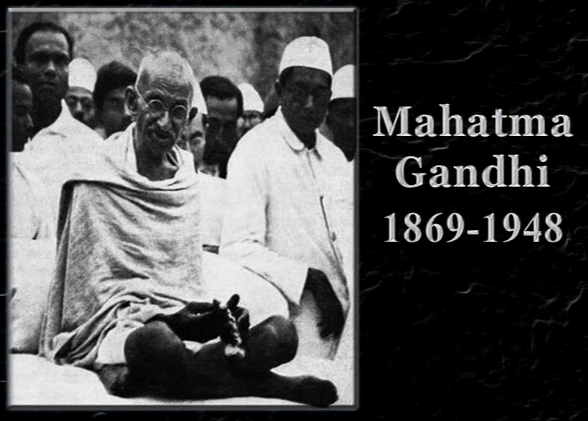
Gandhi’s statements reflect the theme of the Bhagavad Gita. Gandhi said that it is more important to believe that truth is God than that God is truth. Truth comes first. Dharma
God’s presence is everywhere throughout all things in the universe. God makes himself visible in his true form to Arjuna. This God is everywhere throughout the universe. The universe is contained in one atom of this divine being, and in every person, there is a part of this divine being.
In the Bhagavad Gita, the soul endures, is eternal, and is divine. The task of mankind is to purify the soul and gain wisdom and truth so that the soul can gain ultimate liberation.
« Arjuna est l’esprit. Krishna est le véhicule, la manifestation. »
The body is seen as a prison; bodily desires are the result of false knowledge and false wisdom (for example, the desire for power and wealth).

A person who renounces his or her assigned task is doomed to eternal reincarnation and suffering.
The religion of the Bhagavad Gita is not a renunciation of life. It is the call to learn the ultimate meaning of life. The Bhagavad Gita answers the questions of God, good and evil, and fate. It also deals with truth, duty, justice, and love.
The ultimate message of the Bhagavad Gita is that God has created many roads to the truth; each person must find his or her own road.
Book of Exodus
It has shaped three great living religious traditions: Judaism, Christianity, and Islam. Exodus proclaims that God is one and demands that we have no other god but this one God. Moses is his prophet, the man chosen against his will to proclaim the message of God.
The Bhagavad Gita still speaks to mankind today.
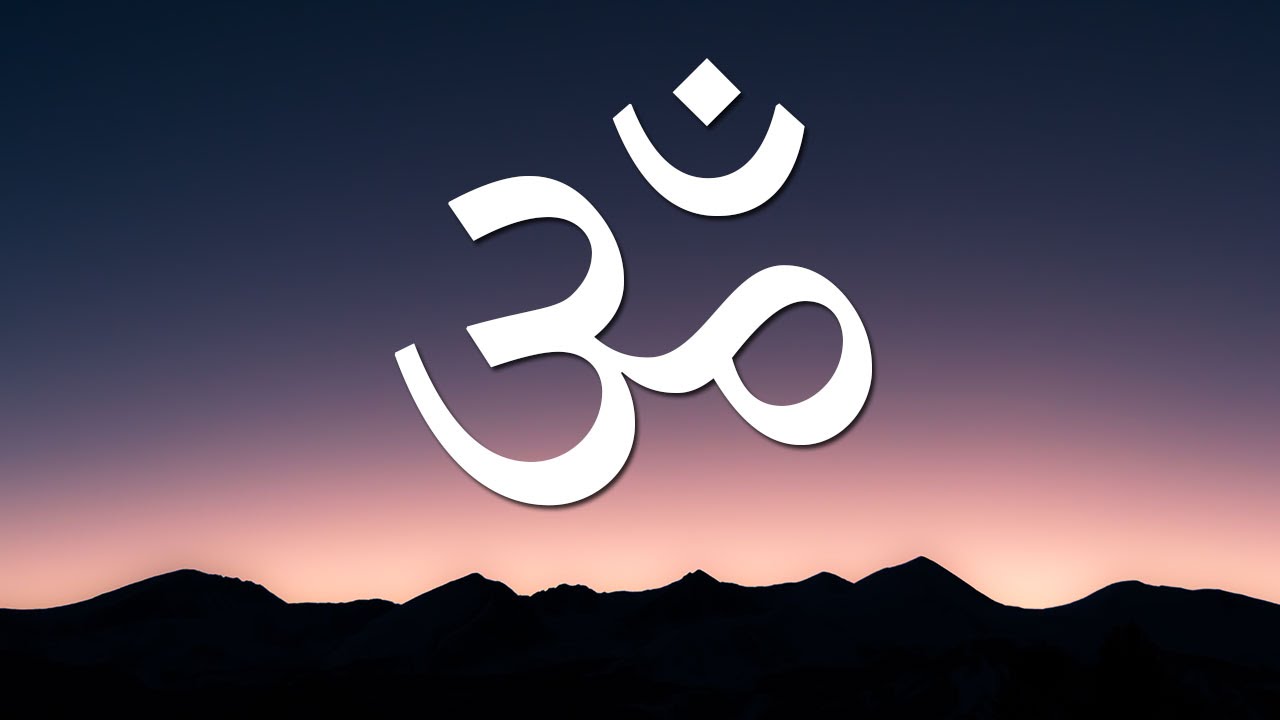
- The word om is the sacred word of God. It is the word with which a person should begin every day and every task that is undertaken simply because it is that person’s work, that person’s task, and that person’s karma.
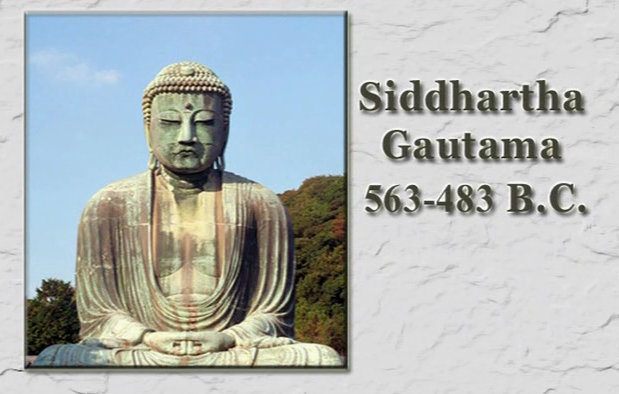
- The ideas in the Bhagavad Gita enlightened Buddha in the 5th and 6th centuries B.C., and Buddhism subsequently shaped the civilizations of China, Korea, Tibet, and Nepal.
The biblical Book of Exodus is the most influential book ever written. Moses was an actual historical figure, and a true historical context exists for the Book of Exodus.

In exile, God found Moses and gave him his calling. When Moses, a shepherd, saw the burning bush, he asked what it was, and God answered, “I am who I am.”
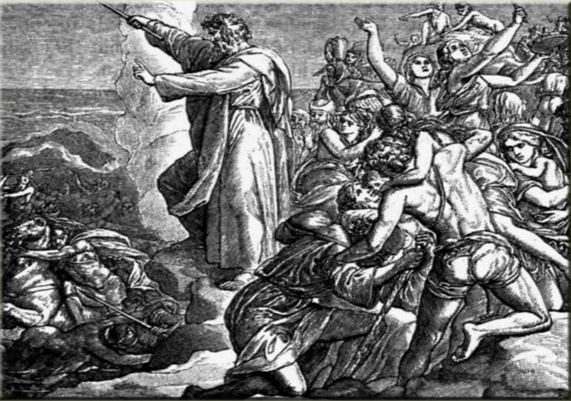
God told Moses that he was to lead the Hebrews from Egypt. Because the pharaoh refused to let the Hebrews leave, God sent the plagues. Although contemporary historians can find practical explanations for these events, they were considered miracles by the Israelites and proofs of God’s power. When the Israelites came to the Red Sea, the sea parted, and they miraculously escaped their Egyptian pursuers.
The tradition that Moses composed the first five books of the Bible may rest on the realization that a people need a common history and common rites that separate them from others. Such Jewish traditions as ritual circumcision and avoidance of pork may represent a legacy of the time that the Israelites spent in Egypt.
Then the Israelites came to the Red Sea, the sea parted, and they miraculously escaped their Egyptian pursuers. This historic event is commemorated in the biblical song of rejoicing: “The horse and his rider He has thrown into the sea. The Lord has triumphed.
After wandering through the desert, Moses brought the Israelites to Mount Sinai, where God spoke to Moses and gave him the law under which the Israelites were to make their absolute submission to God.
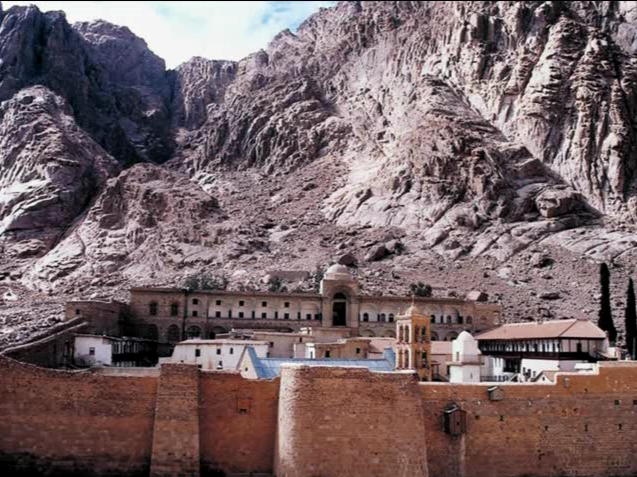
The Ten Commandments reflect what we know about treaties in the Middle East at the time that the Book of Exodus was written (in approximately the 13th century B.C.). In these treaties, an absolute ruler or king makes an agreement to protect a people if they accept his complete domination.
« You will have no other gods besides me” represents monotheism in its most extreme form.
The Book of Exodus is a book of social justice. It elaborates the Ten Commandments and sets up a social system, balancing the need for justice with compassion.
The Israelites moved on and took Canaan by fire and sword, which is also validated by the archaeological record.
Gospel of Mark
The four gospels, Matthew, Mark, Luke, and John, are our sole sources for the life of the teacher and prophet Jesus of Nazareth. Mark is the most concise and dramatic, drawn from the firsthand account of Peter. The power and success of Jesus’ teaching and the uncompromising message that he taught brought Jesus into direct and conscious conflict with the established political and social powers of his day. The Jesus of the Gospel of Mark is a prophet and a philosopher, who testifies to his search for wisdom by his trial and death.
To several fishermen, one of whom was Peter, appeared a man about whom they knew nothing. The man said, “Follow me, and I will make you fishers of men.”
Matthew appears to have been written for a primarily Jewish audience. Luke, the most historically minded of the Gospels, was written for a Gentile audience.
Mark, unlike Luke or Matthew, does not begin with the birth of Jesus or with a long introduction. Instead, it begins with Jesus being called by John the Baptist. After calling Peter and the other fishermen, Jesus went with the men to the town of Capernaum.
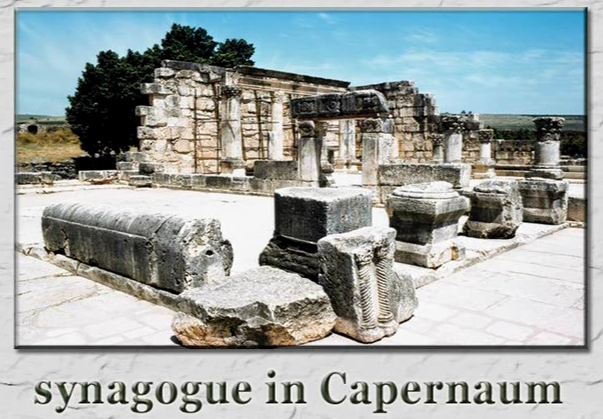
Jesus is believed to have been a learned man. He knew the Hebrew testament and probably knew Greek and Latin, as well as Aramaic, the language of the people.
The Ten Commandments were simple and could be summarized as “Love God and love your neighbor.”
The Essenes, according to Josephus, cut themselves off from the world, lived in monastic conditions, practiced baptism, and spent their days waiting for the coming of the Kingdom of God. They believed that it would come about by copying the word of God. The Dead Sea Scrolls come from this community.
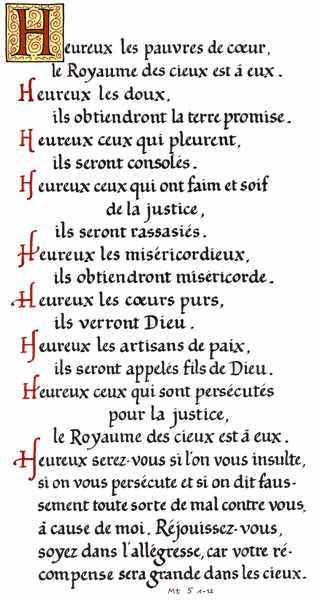
The miracles prompted people to deal with the question of God and whether he was speaking through this prophet or whether Jesus was a false prophet. In the narrative of the Gospel of Mark, these miracles are essential to authenticate the message of Jesus.
(* Jésus est venu enlever les vieilles obligations inutiles, ne mettant l’importance que sur le Contrôle, vides de sens. Son message était spirituel, et ils ne l’ont point compris. Il dérangeait les Juifs pour leurs traditions trop strictes, ainsi que les Pharisiens, qui attendaient un libérateur des Romains, une révolution sociale.*)
The Sanhedrin had absolute control over the internal affairs of Judaea. Jesus was arrested and tried before the court of the Sanhedrin. Caiaphas, the high priest, asked Jesus whether he was the Messiah.
Jesus answered, “Yes, and you will see the son of God coming, seated at the right hand of God, the father.” The Sanhedrin wished to sentence Jesus to death, but only the governor was allowed to impose a death sentence.
Koran
Muhammad is the prophet chosen by God to make this revelation known to the world. The message of the Koran is an uncompromising one of absolute monotheism, focused on the ideal of God as truth, mercy, and power; demanding complete submission and ethical conduct; and rewarding the faithful and punishing those who reject his revelation.
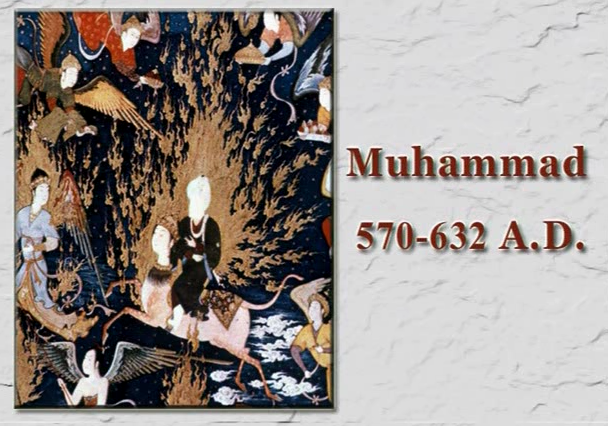
Muhammad was born in Arabia in 570 A.D. to a respected family. At the age of 40, he stepped forward to proclaim that God had chosen him as the messenger of a belief that there was only one God, a God
who demanded ethical righteousness. This was a God of individual salvation who demanded that each person make a decision to follow the truth of God or the lie of Satan. Those who chose to follow the
truth of God would find themselves in paradise, but those who followed the lie of Satan would burn in eternal fire.
Arabia in 570 A.D. was caught between the two great powers of its day. Persia had been revitalized under a monotheistic religion that proclaimed that God was one. Its prophet was Zarathustra. The other power was the Roman Empire, the empire of Christianity, which believed in one God who assumed three persons: the Father, the Son, and the Holy Ghost.
Arabia itself, never occupied by Romans but within Rome’s sphere of influence, was divided into a number of tribes. Political, social, and religious ideas came from as far away as China and Britain through the caravan trade.
In Mecca, it was believed that the Great Black Stone had fallen from heaven and that it embodied the power of the gods. Muhammad learned about the prophets of Judaism and about Jesus. Muhammad respected Christianity as it should be in its purified form, with Christ bringing the message of the one God to the whole world. Muhammad respected Judaism for its message of only one God.
Muhammad believed that the archangel Gabriel had appeared to him and said that Muhammad was to be a messenger from God and that God would proclaim his oneness and his demand for righteousness through Muhammad.
The simple message that Muhammad had received and was to proclaim was the following: God is the only god, and Muhammad is his prophet. God is great, powerful, all-compassionate, all-knowing, and all-seeing. He has created the universe and demands righteous behavior from everyone and calls upon everyone to accept this message.
By the time of Muhammad’s death in 632, he had created a political structure and military force that carried the banner of Islam and worship of one God. The religion ultimately spread through Spain into the Pyrenees to France, to Egypt, Syria, Jerusalem, and into Asia Minor and Persia.
The basic message of Muhammad and the Koran is a simple statement: “There is no god but God and Muhammad is his prophet.” The language in the Koran is believed to be so pure that it cannot be translated. The Arabic language in it is considered to be the word of God. All that a person needs to know is contained in the Koran. The Koran is divided into chapters, but its organization is difficult for
the Western mind to understand. The order is not chronological. Muhammad received these revelations, dictated them, and they were thrown into a large chest. When they were arranged, the arrangement was in backward order chronologically.
There is only one God. Muhammad believed that Christians tried to modify the simple message of Jesus to create three gods. To Muhammad, Christians were polytheists.
If the infidels accept the message in peace or leave believers in peace, they can be tolerated; however, if they take up arms against believers, the believers must wage war. Those who die fighting for the faith of Muhammad will go to paradise. To fight for faith and, if necessary, die for it is one of the highest callings.
Islam means “total submission.”
A Muslim must pray five times a day—in the morning, at noon, in the middle of the afternoon, when the sun begins to set, and in the dark of night. A Muslim must fast during Ramadan, the holy month when God first made himself known to Muhammad. Muslims fast from sunrise to sunset to show their submission to God.
Muhammad believed that Abraham, Noah, Isaiah, and Jesus were Muslims because all submitted themselves to the will of God and preached the existence of one God.
- The message of Muhammad became the religion of Islam.
- Jesus turned the religion of the Jews into one that the Gentiles could understand.
- Plato transformed the message of Socrates to follow the truth into a philosophy.
- All four prophets presented the same powerful message: Be true to yourself and search for your soul.
Gilgamesh
The question of fate or destiny is at the core of the earliest literary work to come down to us, the Sumerian epic of Gilgamesh, composed in the 3rd millennium B.C. in what is now Iraq. He goes in search of eternal life and learns that he must die, but what matters is how he lives, what he achieves during his life, and the reputation that he leaves behind him.
The great civilizations of the past—including those of India, China, Greece, Rome, Mesopotamia, and Egypt—believed that there was no dichotomy between the sacred and the secular. In those cultures, there could be no separation between church and state.
Civilization was born in Egypt and in Mesopotamia. Around 3000 B.C., both areas experienced an astonishing burst of anonymous creativity. These early civilizations were characterized by systems of writing, complex government structures, and monumental architecture. Both the Tower of Babel and the pyramids represented monuments to the belief that no separation existed between the sacred and the secular.
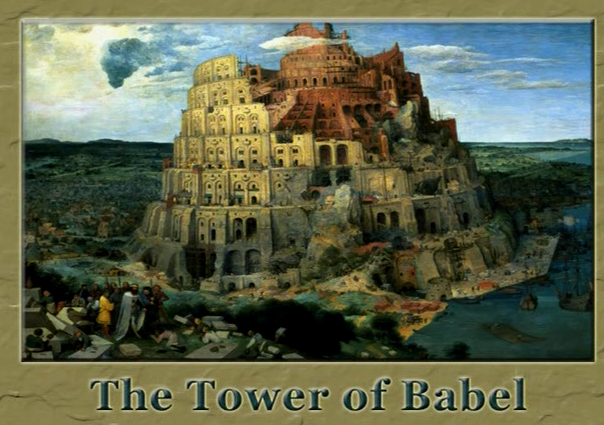
The people of the Nile Valley accepted the belief that the pharaoh was god on earth and built pyramids to celebrate his eternity, the idea that the pharaoh would live forever. The Mesopotamian city-states along the Tigris and Euphrates rivers were also based on the absolute power of the kingship. The king ruled because God had chosen him and placed him on the throne. Even the names of the rulers reflected this status.
- What is our fate? (destin)
- Why do we die?
- Why can’t we live forever?
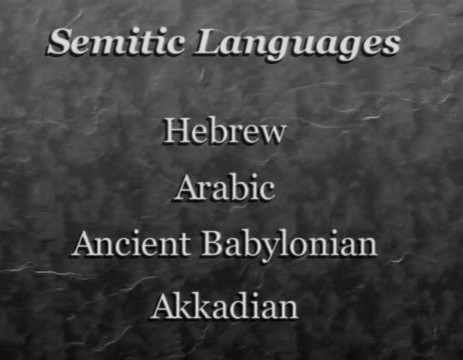
Gilgamesh was a real historical figure, who lived around 2600 B.C. and had been king of Uruk.The poem was written in the language of Babylonia, Akkadian, which was a Semitic language.
The world of Gilgamesh is a polytheistic one; the gods were human and accessible, like the gods of Homer. These gods intervened directly in the world of humans through oracles and dreams. Dreams were a way that the gods told humans what they were to do. The gods chose who would rule, set up codes of law, and made certain that there was no separation between the world of the divine and the world of humans.
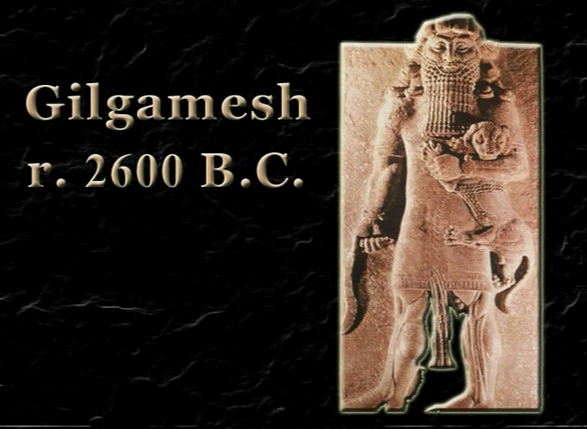
The gods create Enkidu, a wild and uncivilized man who knows nothing of civilization and lives in the world of nature. Enkidu is finally civilized by a temple prostitute. After a trial of strength, Enkidu and Gilgamesh become friends and set off on a series of adventures to make names for themselves so that
people will remember Gilgamesh forever. Together, Enkidu and Gilgamesh conquer and kill the fierce monster Humbaba. Gilgamesh sets out to discover how he can conquer death. He discovers that one man, Ut-Napishtim, is immortal and decides to ask him the secret of immortality.
Beowulf
Gilgamesh proclaims a heroic ideal: We are fated to die, but in the meantime, let us strive to be as great as possible. This same message is the theme of the first great work of English literature, the 8th-century
Anglo-Saxon epic Beowulf. The story of Beowulf, like that of Gilgamesh, is the tale of a mighty warrior who goes in search of adventure and fame. In the guise of monsters, Beowulf encounters the eternal struggle of good against evil. All humans must die.
Seagoing pirates from what is now northern Germany, Denmark, and Sweden attacked Roman Britain as early as the 3rd century A.D. The age of Vikings.
Roman Britannia became England, or “the land of the Angles.”
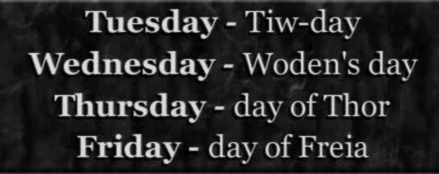
The conquerors brought their Germanic language, Anglo-Saxon, which eventually developed into the English language.
England was divided into warring kingdoms, including North Umbria and Mercia, but these kingdoms gradually adopted Christianity.
The Anglo-Saxons believed that dying with a sword in hand was the best way to die. Such an end would transport an individual to heaven: Valhalla.
Like the world of Gilgamesh and the world of the Odyssey, the world of Beowulf is filled with monsters. These beings, half- human and half-beast, have enormous powers and are evil.
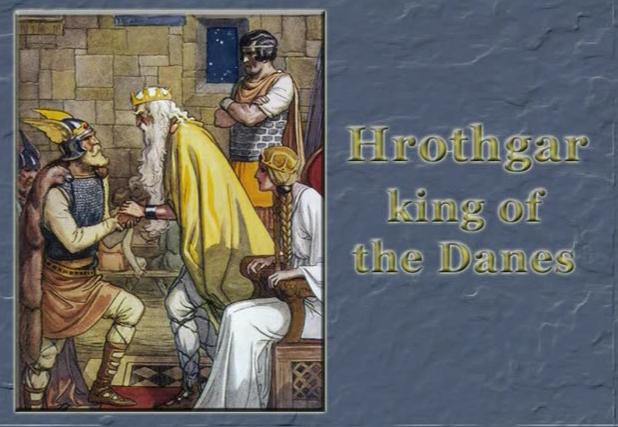
Hrothgar’s kingdom is invaded by Grendel, an evil monster who eats 30 men each night in Heorot.
Honneur et Gloire!
What similarities in themes and treatment do you see between Beowulf and Lord of the Rings? Do you consider Lord of the Rings a great book?
Book of Job
Beowulf, as we have seen, was an exploration of fate. In the world of Beowulf and in the epic of Gilgamesh, poets asked why people must die and whether there is a way to avoid death. After accepting that all people must die, the poets explore how people should live. The heroic image of Beowulf lives and dies, leaving behind the greatest of reputations.
Why do bad things happen to good people? The Book of Job is the most enduring attempt to answer that question. The author of Job took a widespread Middle Eastern folklore motif and transformed it into a dramatic and touching story of human suffering.
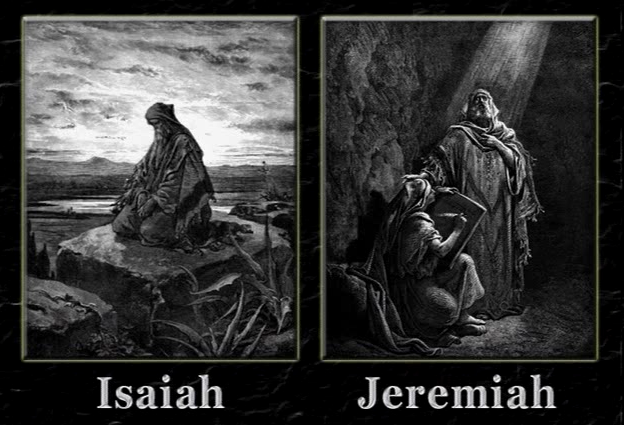
Wisdom literature includes such works as Ecclesiastes and Proverbs, as well as Egyptian works that give practical wisdom.
The Book of Job is also about the idea of conscience. The Old Testament is a statement of the development and evolution of the idea that everyone has a conscience.
The 20th century has all but removed Satan from serious discussion. Hitler and Stalin were 20th-century embodiments of absolute evil. Hitler was able to convince the people of Germany of the righteousness of his cause. The people involved believed that they were carrying out their duty. Evil is more than just an abstraction; it is something that dwells in each individual. It existed in the evil of Hitler and the evil of justifying and acquiescing to it
How do we read the Bible? Translations always put someone between the reader and the author. The King James Version of the Bible represents an eloquent translation of the magnificent language and poetry of Job and the Psalms. The committee that created the translation knew Greek and Hebrew and was working during the age of Shakespeare, an era when the English language had reached perfection in flexibility and eloquence. The King James Version of the Bible is written in language that ennobles the soul.
Aeschylus, Oresteia
L’Orestie (en grec Ὀρέστεια / Orésteia) est une trilogie dramatique d’Eschyle représentée en 458 av. J.-C. aux Grandes Dionysies d’Athènes.
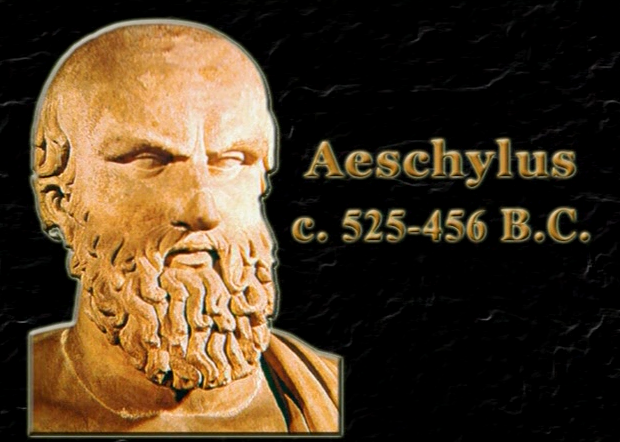
Greek tragedy was developed at Athens to encourage public reflection on the most profound moral questions. Tragedy spoke to the belief that all political actions have moral consequences. Tragedy tell us that there is no separation between private and public morality. The Oresteia is a trilogy, consisting of three plays: Agamemnon, Libation-Bearers, and Eumenides. The story of murder, revenge, duty, and divine intervention raises in stark form the dilemma of free will. Far from being automatons in the grip of a remorseless destiny, the characters in the Oresteia are possessed of free will. The purpose of Aeschylus in the Oresteia is to give us the wisdom to make the right choices and take the right action.
Aeschylus lived from 525 B.C. to 456 B.C., at approximately the same time that the Book of Job was composed. His Oresteia was produced in 458 B.C.
The Athenian society was the first democracy in history. The Athenians developed a forum for the public discussion of fundamental values, asking such questions as whether a set of values exists that must guide people. Central to the question of whether a fundamental set of values exists was the question of whether the individual has free will or whether everything is fated to happen to the individual, who has no power to change it.
Aeschylus believed that the question was not that simple. If free will does not exist, then it becomes difficult to take responsibility for one’s actions.
- Agamemnon opens at the end of the Trojan War.
- The Libation Bearers deals with Electra and Orestes, the daughter and son of Clytemnestra and Agamemnon.
- The third work in the trilogy is Eumenides, or “the blessed ones.”
The Oresteia explores several questions. Can public and private morality be separated? Is Agamemnon’s murder of his daughter a private act or a public act? Part of Agamemnon’s policy had been to sail to Troy, a public act, but to do so, he sacrificed his daughter, a private act. Aeschylus indicates that public and private morality cannot be separated.
The lesson of the Oresteia is that people make choices and are responsible for the consequences that follow.
Euripides, Bacchae
Like the Oresteia, the Bacchae asks whether absolute values, absolute good, and absolute truth exist, or whether such concepts as good and truth depend on circumstances and perceptions.
Sophists educated young Athenians. They taught their pupils the arts of oratory and persuasion and to think critically, that is, to question values. These sophists believed that circumstances determine our perceptions of events and our perceptions of the divine world.
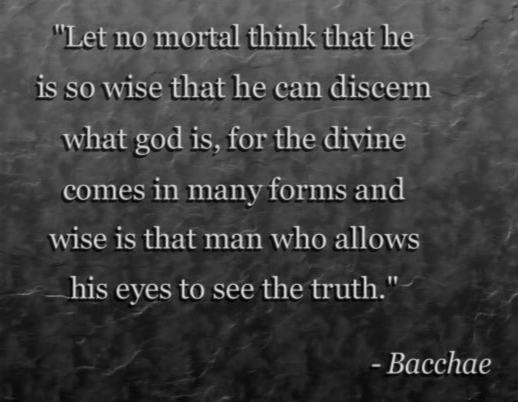
Euripides wrote the Bacchae in 406 B.C. in Pella, in Macedonia.
We only learn wisdom from suffering.
Dionysos was the son of Zeus by a mortal woman. He suffers and is brought back to life by his father.

Timeline
B.C.
3000 ………………………………………… Birth of civilization in the Near East and Egypt
2500 ………………………………………… Pyramids of Giza in Egypt
2500 ………………………………………… Indus Valley civilization in India
2000 ………………………………………… Stonehenge
1760 ………………………… Shang Dynasty in China, first historical dynasty, with writing and bronze artworks
1500 ………………………………………… Aryan invasion of India
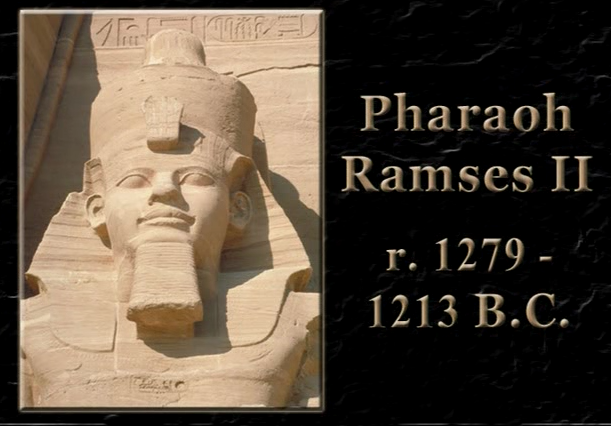
1295–1225 ……………………………….. Ramses II, pharaoh of Egypt; historical context for the Exodus
1250 ………………………………………… Trojan War
1027–56 …………………………………… Zhou Dynasty in China, political context for Confucius (551–479)
1000 ………………………………………… Beginning of Sanskrit literature
563–483 …………………………………… Buddha
550–531 …………………………………… Persian Empire rules the Middle East
490–404 …………………………………… Golden age of Athenian democracy
336–323 …………………………………… Alexander the Great
218–146 …………………………………… Rise of the Roman Empire
48–31 ………………………………………. Julius Caesar and Augustus establish monarchy in the Roman Empire
A.D.
31 B.C.–180 A.D…………………………. Golden age of the Roman Empire
6 ……………………………………………… Birth of Jesus
312 …Conversion of the Roman emperor Constantine to Christianity, which became the official religion of the Roman Empire
476 ………………………………………….. Fall of the Roman Empire in Western Europe
800 ………………….. Charlemagne establishes what became the Holy Roman Empire of the German Nation
1066 ………………………………………… Norman Conquest of England
1194–1500 ……………………………….. Gothic art and architecture dominate Europe
1215 ………………………………………… Magna Carta
1304–1527 ……………………………….. Renaissance
1517–1648 ……………………………….. Reformation
1558–1603 ……………………………….. Queen Elizabeth I of England
1648–1789 ……………………………….. Age of the Enlightenment
1775–1789 ……………………………….. American Revolution and Constitution, “The Founding”
1789–1815 ……………………………….. French Revolution and Napoleon
1860–1914 ……………………………….. Golden age of the British Empire
1861–1865 ……………………………….. American Civil War
1914–1918 ……………………………….. World War I
1929–1953 ……………………………….. Joseph Stalin rules the Soviet Union
1933–1945 ……………………………….. Adolf Hitler rules Germany
1945– ……………………………………… Scientific and technological revolution
1990– ……………………………………… United States as the world’s only superpower
 Domaines d'études